
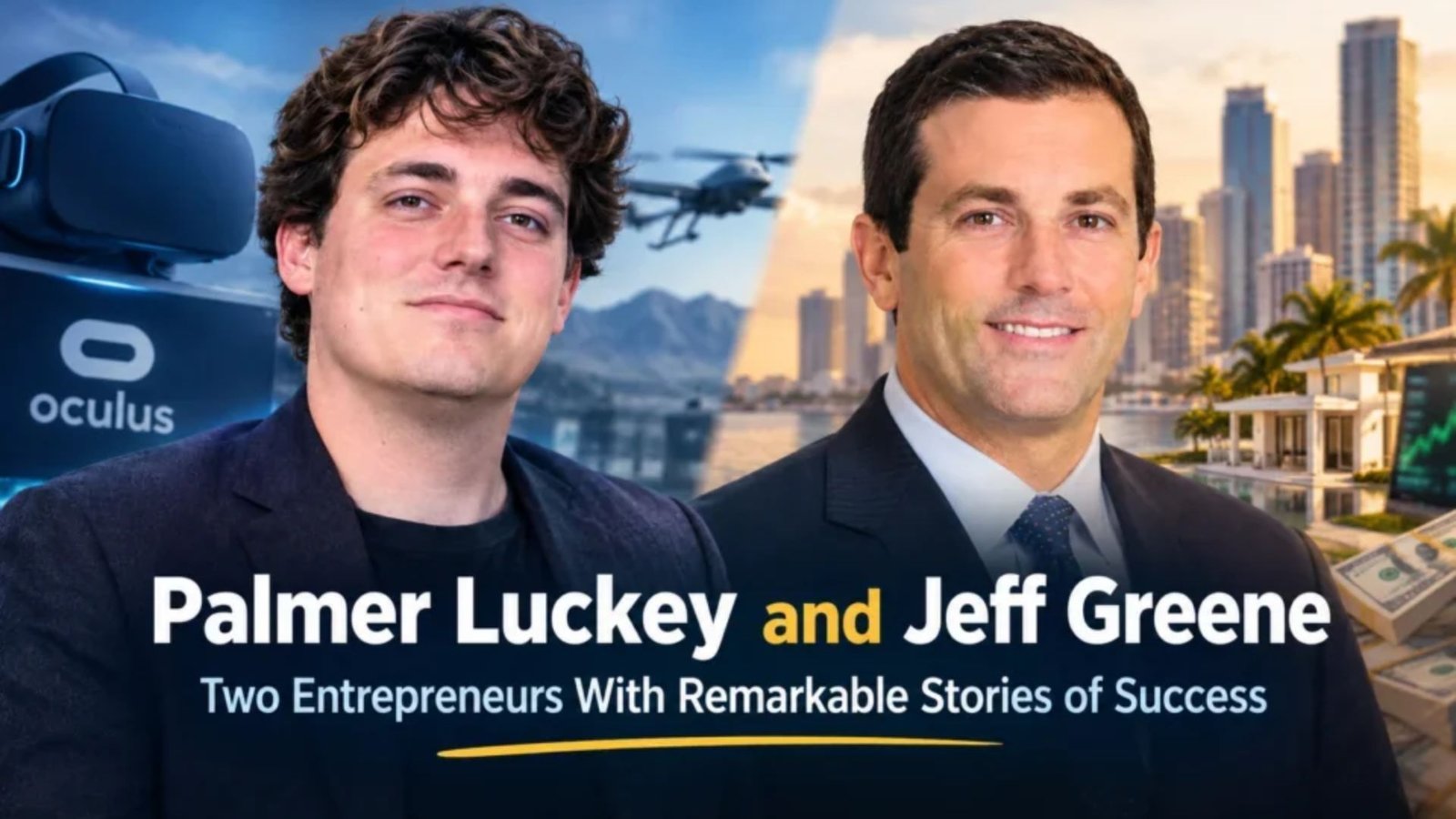
Palmer Freeman Luckey is an American entrepreneur and inventor. He is best known for founding Oculus VR and Anduril Industries. Jeff Greene is a successful American real estate investor. He made much of his fortune through property and mortgage investments. Both men have earned billionaire status through different careers. However, many people wonder whether Palmer Luckey and Jeff Greene share a family or business connection. Their stories reveal two very different paths to success. One built wealth through technology while the other focused on real estate and financial markets.
Their net worth also attracts considerable public interest. Forbes estimates Palmer Luckey’s net worth at $5.9 billion. Jeff Greene’s net worth stands around $10.1 billion. These figures reflect their business interests and investments. However, private company shares and property values can change. This article examines their backgrounds, careers, wealth, and personal lives. You’ll also discover whether any verified connection exists between them.
Quick Facts: Palmer Luckey vs Jeff Greene
Palmer Luckey and Jeff Greene have different backgrounds. However, both built substantial personal fortunes.
The following table summarizes their publicly reported details. It also identifies information that remains unavailable.
| Quick facts | Palmer Luckey | Jeff Greene |
| Full name | Palmer Freeman Luckey | Jeff Greene |
| Age (November 2026) | 34 years | 71 years |
| Birth date | September 19, 1992 | December 10, 1954 |
| Birthplace | Long Beach, California | Worcester, Massachusetts |
| Height | Not publicly disclosed | Not publicly disclosed |
| Weight | Not publicly disclosed | Not publicly disclosed |
| Spouse | Not publicly confirmed in current Forbes profile | Mei Sze Chan |
| Children | Not publicly disclosed | Three |
| Education | California State University, Long Beach (attended) | Johns Hopkins University, Harvard University |
| Net worth | Approximately $5.9 billion | Approximately $10.1 billion |
| Profession | Inventor and technology entrepreneur | Real estate investor and developer |
| Known for | Oculus VR and Anduril | Real estate and mortgage investments |
| Residence | Newport Beach, California | Palm Beach, Florida |
| Social handles | Not independently verified | Not independently verified |
Net worth figures reflect Forbes reporting available November 2026. Personal details are limited to publicly documented information.
Luckey became famous through virtual reality technology. Greene gained attention through real estate investments. Their ages also reveal a substantial difference. They belong to different business generations.
Are Palmer Luckey and Jeff Greene Related or Business Partners?
No, Palmer Luckey and Jeff Greene have no documented relationship. No reliable public record establishes family ties or shared business ownership. Their professional backgrounds also remain quite different.
Luckey works mainly in technology and defense. Greene concentrates on property and financial investments. Their similar billionaire status creates curiosity. However, wealth alone doesn’t establish a connection.
What the public record shows
Public biographies describe two separate family backgrounds. Palmer Luckey grew up in Long Beach, California. Jeff Greene was born in Worcester, Massachusetts.
Luckey’s public career centers around Oculus and Anduril. Greene’s career centers around property and investing. Their known business interests don’t establish any partnership.
Their personal lives also have separate public records. Greene is married to Mei Sze Chan. The couple has three children together. Forbes currently lists Luckey as single. His private family details shouldn’t be guessed.
Neither man’s established biography identifies the other. No verified shared company has emerged publicly. There is also no documented joint investment.
Therefore, claims about family connections remain unsupported. The same applies to partnership rumors.
Read Also: Aaron Rodgers and Radhakishan Damani: What We Actually Found
Why their names are searched together
Search interest often brings unrelated billionaires together. People naturally compare wealthy American entrepreneurs. Both men have appeared on Forbes lists.
Their wealth also comes from unusual opportunities. Luckey recognized the potential of virtual reality. Greene recognized risks within the housing market.
Their stories offer an interesting comparison. One developed technology with global commercial potential. The other made financial bets against mortgages.
Search engines also connect similar public figures. Comparison articles often answer common reader questions. However, search visibility doesn’t prove personal connections.
If someone claims they’re business partners, check evidence. Company filings and direct statements matter. Unverified claims shouldn’t become established facts.
Palmer Luckey and Jeff Greene Net Worth in 2026
Jeff Greene currently has the higher estimated fortune. Forbes lists Luckey at approximately $5.9 billion. Greene’s estimated fortune stands around $10.1 billion. These figures reflect different wealth sources.
Forbes real-time profiles, November 16 and 17, 2026.
| Financial detail | Palmer Luckey | Jeff Greene |
| Estimated net worth | $5.9 billion | $10.1 billion |
| Main wealth source | Technology and defense | Real estate and investments |
| Major business | Anduril Industries | Real estate holdings |
| Important financial event | Oculus acquisition | Subprime mortgage trade |
| Forbes 400 | Listed | Listed |
Greene’s estimated fortune exceeds Luckey’s considerably. However, these figures aren’t fixed amounts. Private company shares can change their value. Property prices also shift with market conditions.
Why net worth figures differ across websites
Different websites publish different billionaire estimates. Some figures come from older financial reports. Others use changing market information and estimates.
For example, Forbes valued Luckey differently previously. His estimated fortune grew with Anduril’s valuation. That company reached $61 billion in May 2026.
Greene’s wealth also reflects changing property values. His holdings include residential and commercial properties. His financial investments add another valuation layer.
Always check three details before quoting wealth figures:
- Publication date: Older estimates might be outdated.
- Original source: Prefer established financial publications.
- Valuation method: Real-time estimates differ from rankings.
Forbes published its 2026 Forbes 400 ranking. Its valuation snapshot used September 4, 2026. Greene’s listed fortune reached $10.1 billion. Luckey’s estimated fortune reached approximately $5.9 billion.
tollbit.forbes.com+2
Why private stakes and property are hard to value
Private businesses don’t trade on public exchanges. Their shares lack constantly available market prices. Investors instead negotiate values during funding rounds.
Anduril provides a useful example here. Its May 2026 funding round reached $61 billion. That valuation doesn’t equal Luckey’s personal fortune. His ownership represents only part of company value.
Real estate creates another valuation challenge for Greene. A building’s estimated value can change quickly. Debt, maintenance, and operating costs matter too. Selling property also takes time and money.
Consider a simple property example here. An investor owns a building worth $50 million. Outstanding loans reduce the owner’s actual equity. Selling costs can reduce the final proceeds. Personal wealth depends on the remaining amount.
The same principle applies to private companies. Company valuation and personal net worth differ. Ownership percentages make an important difference.
Who Is Palmer Luckey?
Palmer Luckey is an American inventor and entrepreneur. He founded Oculus VR and Anduril Industries. His work connects virtual reality with defense technology. He became a billionaire through technology investments.
His journey started with personal technical experiments. He developed an early interest in headsets. Eventually, that interest became a major company.
Early Life and Education
Palmer Freeman Luckey was born September 19, 1992. His hometown was Long Beach, California. His mother homeschooled him during childhood.
He developed technical interests at an early age. His father also encouraged hands-on experimentation. Luckey spent considerable time building electronics.
Virtual reality soon became his main interest. He collected older headsets and studied designs. Many devices offered poor performance and comfort. He wanted to improve that experience.
He attended several colleges during his teenage years. These included Golden West and Long Beach City. Later, he studied at California State University, Long Beach. He eventually left college to build Oculus.
pepperdine.edu+1
His early experiments shaped his future career. He didn’t follow a traditional corporate path. Instead, he pursued a technical business opportunity.
Oculus VR and the Facebook Acquisition
Oculus VR became Luckey’s first major breakthrough. He founded the company in April 2012. His initial goal involved affordable virtual reality.
The Oculus Rift attracted early technology enthusiasts. A Kickstarter campaign helped fund development. The project received strong attention from supporters.
Facebook announced its Oculus acquisition during 2014. The transaction carried a reported $2 billion value. The deal included cash and company stock. It introduced Oculus to a much larger platform.
Facebook’s acquisition became a major turning point. It connected Luckey with Mark Zuckerberg’s company. It also increased public interest in VR.
Luckey’s exact financial proceeds remain undisclosed. Therefore, his personal profit isn’t precisely known. Still, the acquisition helped establish his fortune.
Why the Oculus deal mattered:
- It brought virtual reality mainstream attention.
- Facebook gained an important technology platform.
- Luckey became a recognized technology entrepreneur.
- The transaction created substantial financial opportunities.
The acquisition also shaped his later investments. He gained experience building technology businesses.
Leaving Facebook and the Road to Anduril
Luckey left Facebook during March 2017. Reports connected his departure with political controversy. Facebook didn’t publicly establish one definitive reason.
His next major move involved defense technology. He joined several experienced technology entrepreneurs. Together, they developed a new business idea.
Luckey founded Anduril Industries during June 2017. His co-founders included Matt Grimm and Trae Stephens. Brian Schimpf and Joe Chen also participated.
Their goal involved modern defense technology systems. They wanted faster development and better integration. The company focused on software and hardware.
Anduril became Luckey’s second major business chapter. Its growth changed his financial profile significantly.
Anduril Industries Today
Anduril Industries is a major defense technology company. It develops autonomous systems for military customers. Its products include drones, sensors, and software.
The company’s approach combines hardware with software. Its systems help monitor complex security environments. They also support military operations and awareness.
In May 2026, Anduril raised $5 billion. The funding round valued the company at $61 billion. Thrive Capital and Andreessen Horowitz led investment.
reuters.com+1
That valuation represented a major business milestone. It also strengthened Luckey’s billionaire wealth position.
Reuters reported another important development in July. Anduril discussed funding at roughly $100 billion. However, those talks remained preliminary at publication. The company hadn’t announced a completed transaction.
investing.com+1
Anduril’s work includes several important technologies:
- Autonomous drones for defense operations.
- Sensors designed for security monitoring.
- Software connecting different military systems.
- Artificial intelligence supporting defense applications.
- Hardware designed for demanding environments.
The company continues expanding its defense business. Its future valuation depends on execution and demand.
Other Ventures
Luckey’s business interests extend beyond Anduril. He has supported several technology-related ventures. These include Erebor and ModRetro.
Erebor focuses on digital banking services. Its concept targets technology and cryptocurrency businesses. ModRetro focuses on retro gaming products.
These ventures reflect his broader technical interests. They also show his willingness to experiment. However, their financial contributions remain unclear.
His main wealth driver remains Anduril equity. Oculus also played an important early role. Together, these businesses shaped his financial story.
Latest News: Luckey and California’s Proposed Wealth Tax (Oct 2026)
Luckey attracted attention during October 2026. His comments concerned California’s proposed billionaire tax. The proposal targets certain wealthy state residents.
The proposed measure involves a one-time tax. Its headline rate stands at five percent. It would apply to qualifying billionaire residents’ assets.
Luckey publicly criticized the proposed measure. However, he said he would remain in California. He also expressed interest in fighting for the state.
TechCrunch reported his comments on October 27. Forbes also covered his position afterward. His statements reflected his personal policy concerns.
TechCrunch+1
The proposal raises several important financial questions:
- How would private company shares be valued?
- How would founders pay the proposed tax?
- Could ownership sales affect private companies?
- What impact might relocation decisions create?
The measure’s final outcome wasn’t settled then. Its legal and financial effects remain important. Luckey’s position is a documented public statement.
Who Is Jeff Greene?
Jeff Greene is an American real estate investor and developer. He became wealthy through property and financial investments. His famous mortgage trade strengthened his early fortune. Today, he ranks among America’s wealthiest investors.
Greene built his career through several financial cycles. His story includes property deals and philanthropy. He also explored politics during his career.
Early Life and Education
Jeff Greene was born December 10, 1954. His birthplace was Worcester, Massachusetts. He grew up in a working-class family.
His childhood involved several ordinary jobs. He reportedly shoveled snow and delivered newspapers. Those experiences helped develop his work ethic.
Greene attended Johns Hopkins University for college. He later earned an MBA from Harvard. He supported his education through different jobs.
His early working experiences shaped his outlook. He understood the value of careful spending. He also developed an interest in investing.
While studying at Harvard, Greene discovered property. He purchased a multifamily house near campus. Renting rooms helped cover his housing costs.
This small investment became a major beginning. He gradually expanded his real estate holdings.
tollbit.forbes.com+2
Early Real Estate Investments
Greene began investing while attending business school. His first property purchase involved multiple apartments. Rental income helped cover his mortgage payments.
He continued purchasing properties after graduation. His investments expanded beyond the Boston area. Later, he established himself in California.
However, property markets weren’t always favorable. He experienced difficult real estate market conditions. Those periods tested his financial strategy.
Greene continued studying property prices and opportunities. He focused on locations with growth potential. His portfolio eventually expanded across several states.
His approach combined patience with financial research. Property ownership became his main wealth foundation.
The Subprime Mortgage Bet and the 2008 Crisis
Greene’s famous investment involved subprime mortgage bonds. He anticipated serious problems within housing finance. His strategy used credit default swaps.
These financial contracts can protect against defaults. They can also generate profits when bonds collapse. However, incorrect timing can create heavy losses.
Greene reportedly invested around $50 million initially. His trades began during 2006 and 2007. He focused on mortgage-backed securities.
The housing market eventually suffered a major collapse. Many borrowers struggled to repay their mortgages. Mortgage-backed investments lost substantial market value.
Greene’s position benefited from that market decline. Forbes has reported approximately $800 million profits. That trade helped establish his billionaire status.
forbes.com+1
How credit default swaps work:
- An investor purchases protection against defaults.
- The investor pays agreed contract premiums.
- The underlying bond experiences a credit event.
- The contract may generate a substantial payout.
- Incorrect predictions can cause major losses.
Greene’s strategy depended heavily on timing. His research helped him identify housing risks. However, similar trades don’t guarantee future success.
The financial crisis changed his investment opportunities. He later used profits to purchase property.
Greene’s Property Portfolio
Jeff Greene built a substantial property portfolio. His holdings include residential and commercial real estate. Hospitality investments have also supported his wealth.
His known interests include several Florida properties. One important development is called One West Palm. The project features two residential towers.
He also owned the Tideline Ocean Resort. The property operated in Palm Beach, Florida. Greene purchased it through his business interests.
In September 2026, the resort changed ownership. Fort Partners acquired the hotel for $150 million. The reported transaction included property-related assets.
costar.com+1
Another significant property deal involved West Palm. Terra and BH Group pursued a purchase. The reported price reached approximately $100 million. The site was located on North Flagler Drive.
therealdeal.com+1
Greene also listed two Manalapan properties. Their combined asking price reached $99 million. The listing appeared during May 2026.
AOL
His property portfolio shows different investment strategies:
- Residential properties generate potential rental income.
- Commercial buildings provide business investment opportunities.
- Hotels offer hospitality-related revenue opportunities.
- Development land can appreciate over time.
- Strategic sales can release invested capital.
Real estate values depend on several factors. Location remains especially important for property owners. Financing costs can also affect profitability.
Political Campaigns
Greene also explored American electoral politics. He participated in two major Florida campaigns.
During 2010, Greene ran for Senate. He competed in the Democratic primary election. Kendrick Meek ultimately defeated him.
Greene later pursued Florida’s governor position. He entered the Democratic primary during 2018. Andrew Gillum won that primary election.
Ballotpedia+1
His campaigns involved substantial personal spending. However, neither campaign secured the nomination.
These political activities became part of his biography. They also demonstrated interests beyond business.
Philanthropy and The Greene School
Greene and his wife support educational philanthropy. Together, they founded The Greene School. It opened in West Palm Beach during 2016.
The institution focuses on talented young students. Its mission supports learning and personal development. The school later expanded its grade offerings.
The Greene School+1
Greene’s philanthropic activities extend beyond education. His family has supported several community initiatives. Education remains a visible priority for them.
Another major contribution involved Vanderbilt University. Greene and his wife donated eight land parcels. The donation supports Vanderbilt’s planned campus. The announcement came during March 2026.
Vanderbilt University+1
The donation strengthened Vanderbilt’s West Palm plans. It also demonstrated Greene’s community involvement.
Career Timeline: Luckey and Greene at a Glance
Their careers developed across different generations. However, both identified unusual financial opportunities. Their timelines explain their major milestones.
| Year | Palmer Luckey | Jeff Greene |
| 1954 | Not yet born | Born in Worcester |
| 1992 | Born in Long Beach | Already an established adult |
| 2006 | Developing technology interests | Begins subprime mortgage trades |
| 2007 | Continues technical experiments | Expands mortgage-related positions |
| 2008 | Still developing his career | Benefits from housing market collapse |
| 2012 | Founds Oculus VR | Expands investment activities |
| 2014 | Facebook acquires Oculus | Continues real estate investments |
| 2016 | Builds post-acquisition career | Helps establish The Greene School |
| 2017 | Founds Anduril Industries | Continues Florida property investments |
| 2018 | Expands defense technology business | Runs for Florida governor |
| 2026 | Anduril reaches $61 billion valuation | Makes major property and education contributions |
The timeline highlights different financial approaches. Luckey developed businesses around emerging technology. Greene invested through property and financial markets.
Both experienced major wealth-building opportunities. Their stories also show the importance of timing.
Palmer Luckey vs. Jeff Greene: Key Similarities and Differences
Palmer Luckey and Jeff Greene share billionaire status. However, their business models remain different. Their financial foundations also require different valuation methods.
| Comparison | Palmer Luckey | Jeff Greene |
| Main industry | Technology and defense | Real estate and investing |
| Main companies | Oculus and Anduril | Real estate businesses |
| Major wealth event | Facebook’s Oculus acquisition | Subprime mortgage trade |
| Investment style | Company ownership and technology | Property and financial contracts |
| Main location | California | Florida |
| Education | College studies without graduation | Johns Hopkins and Harvard MBA |
| Philanthropic interests | Public record remains limited | Education and land donations |
| Estimated net worth | $5.9 billion | $10.1 billion |
One similarity involves taking calculated risks. Luckey pursued an emerging technology market. Greene anticipated problems within mortgage investments.
Another similarity involves asset ownership. Luckey holds interests in private companies. Greene holds property and financial investments.
Their differences become clearer through liquidity. Publicly traded assets offer visible market prices. Private company shares require valuation estimates. Real estate requires appraisals and market analysis.
Neither fortune represents cash sitting in banks. Both depend on underlying asset values.
What Their Careers Teach About Building Wealth
Their financial journeys offer useful lessons. Both stories show how wealth develops. However, their strategies aren’t interchangeable investment advice.
1. A Company Valuation Is Not Personal Wealth
A company’s valuation represents its estimated business value. It doesn’t represent one founder’s personal fortune.
Anduril demonstrates this distinction very clearly. Investors valued the company at $61 billion. Luckey doesn’t personally own the entire business.
His estimated wealth depends on ownership interests. Other investors and employees also hold stakes. Company debt and other obligations matter.
The same principle applies to property investments. An investor’s equity differs from property value. Outstanding loans reduce the owner’s actual position.
Remember this important financial distinction:
- Company value measures the entire business.
- Ownership percentage determines individual equity exposure.
- Debt reduces the owner’s net assets.
- Taxes and selling costs affect final proceeds.
2. Timing Risk Cuts Both Ways
Greene’s mortgage trade demonstrates timing risk. His strategy depended on anticipating housing problems. He positioned himself before the major collapse.
However, similar trades can fail badly. Markets don’t always follow expected timelines. Investors can lose money while waiting.
Luckey’s experience involved a different kind of risk. He entered virtual reality before mainstream adoption. His company needed technology and market development.
Both opportunities required patience and conviction. Neither outcome was guaranteed at the beginning.
3. Assets Reprice Fast
Asset values can change within months. Private companies depend on investor expectations. Properties depend on demand and financing.
Anduril’s valuation reached $61 billion in May. Its earlier 2025 valuation was $30.5 billion. That represents a substantial increase within one year.
reuters.com+1
Greene’s property transactions show similar changes. His West Palm land attracted a reported $100 million deal. His earlier purchase reportedly cost much less.
These examples demonstrate changing asset values. However, headline prices aren’t guaranteed personal profits.
Investors should examine ownership and outstanding debt. They should also check transaction dates carefully.
FAQ’s
Who are Palmer Luckey and Jeff Greene?
Palmer Luckey is an American technology entrepreneur. He founded Oculus VR and Anduril Industries. Jeff Greene is an American real estate investor. He became wealthy through property and mortgage investments.
Are Palmer Luckey and Jeff Greene related?
No, there’s no verified family connection. Their backgrounds and professional careers are different. No documented business partnership connects these billionaires.
What is Palmer Luckey’s net worth?
Forbes estimates Palmer Luckey’s net worth at $5.9 billion. Its November 2026 profile reports this figure. His wealth mainly comes from Anduril equity. His earlier Oculus sale also contributed significantly.
What is Jeff Greene’s net worth?
Jeff Greene’s estimated net worth is $10.1 billion. Forbes reported this amount during November 2026. His wealth comes mainly from property investments. His famous mortgage trade also built his fortune.
How did Palmer Luckey make his money?
Luckey initially built wealth through Oculus VR. Facebook acquired Oculus during 2014 for $2 billion. He later founded Anduril Industries during 2017. Its growing valuation increased his estimated fortune.
How did Jeff Greene become a billionaire?
Greene invested in credit default swaps during 2006. These contracts targeted subprime mortgage-backed bonds. The housing collapse helped generate substantial profits. Forbes reports his earnings reached approximately $800 million.
Conclusion
Palmer Luckey and Jeff Greene have built successful careers in different fields. Palmer Luckey made his fortune through Oculus VR and Anduril Industries. Jeff Greene earned his wealth through real estate and smart investments. Their stories show how different paths can lead to great success. However, there is no verified family or business connection between them. Their backgrounds, careers, and investments remain separate. Both men have also gained attention for their impressive financial achievements.
The Palmer Luckey and Jeff Greene net worth comparison shows a clear difference. Luckey has an estimated net worth of $5.9 billion. Greene’s estimated net worth stands at $10.1 billion. These figures may change with business and property values. Still, both men remain successful American billionaires. Their journeys offer useful lessons about money, hard work, and taking risks. Always check updated sources when discussing their wealth.

QuotesRipple is a collection of inspiring quotes and thoughtful sayings, managed by Ryan Mitchell, an SEO content writer with 2 years of experience, dedicated to publishing motivational content that leaves a lasting impression.
1 thought on “Palmer Luckey and Jeff Greene: Net Worth & Are They Related?”