
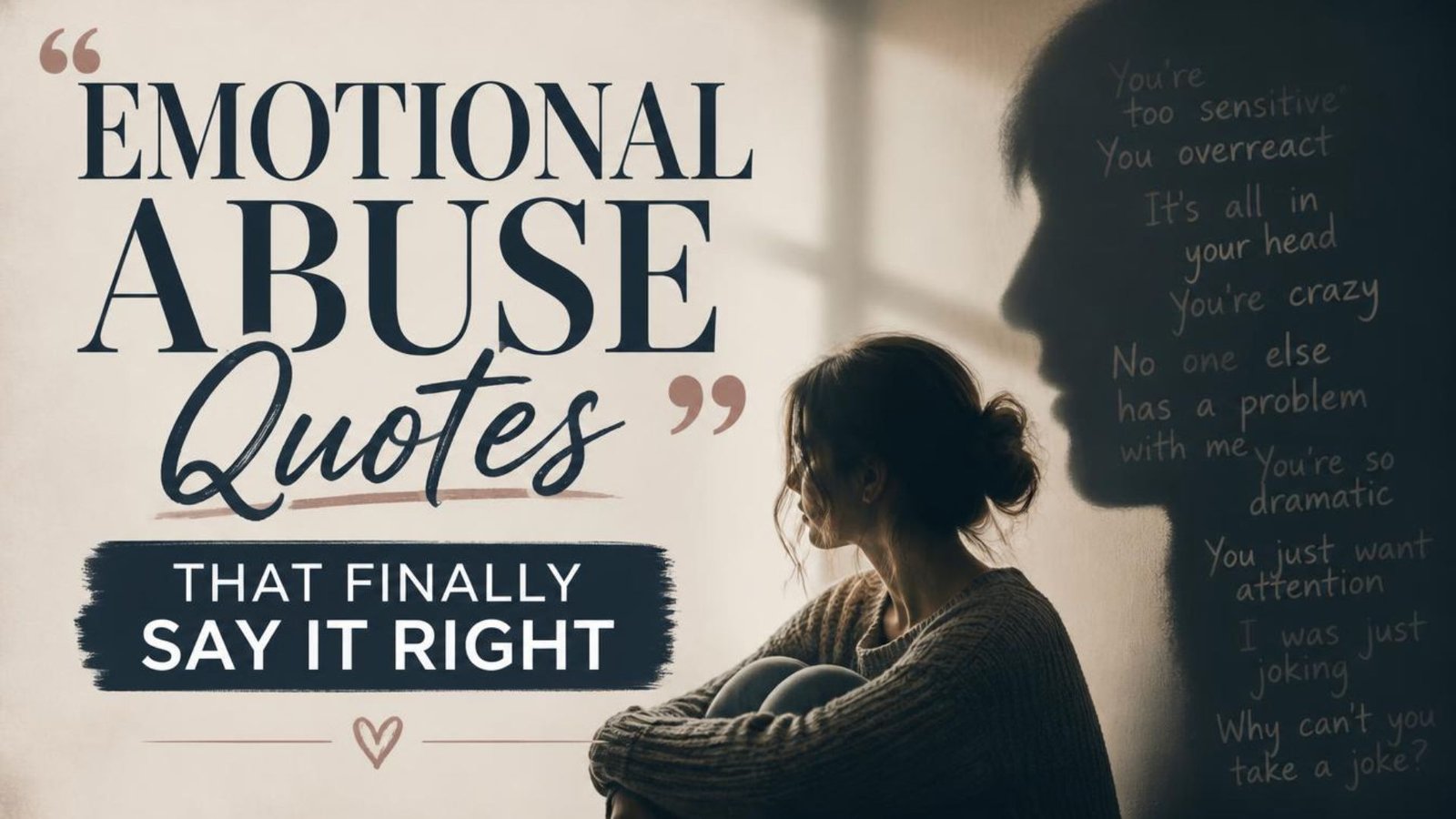
Some pain never leaves a mark. It just leaves a feeling you can’t shake. That’s why so many people search for Emotional Abuse Quotes. They’re looking for words to explain something they’ve never been able to say out loud. No bruises. No proof. Just a quiet certainty that something was wrong all along.
This collection of Emotional Abuse Quotes exists for exactly that moment. Some lines will feel gentle. Others will hit hard and fast. Read slowly. Keep what fits your story. Leave the rest for later. You’ll know the right words when you find them.
Maya, Tuesday Night, 11:05 PM
Late at night, alone, is often when the truth gets loud. This is the moment many people first reach for words that actually fit their story.
Sitting in silence can feel safer than saying the word “abuse” out loud. These lines speak to that quiet, private hour.
- She sat in the dark, finally ready to listen.
- The silence at midnight said more than daylight ever did.
- Some truths only surface when no one else is watching.
- The floor felt safer than facing the whole room tonight.
- She wasn’t crying over him. She was crying over years.
- The journal stayed closed, but the question stayed open.
- Eleven at night is when the mind stops performing okay.
- She needed a smaller space to hold a bigger feeling.
- The podcast paused. Her own thoughts got louder instead.
- Some nights the only honest company is your own memory.
What Is Emotional Abuse?
Emotional abuse is a repeated pattern of control, not a single unkind moment. It works through isolation, blame, and slow erosion of confidence.
Naming it clearly is the first step toward healing. These quotes describe the shape of harm that leaves no visible trace behind.
- Abuse is a pattern, never just one bad night.
- Control dressed as love is still control, not love.
- You don’t need bruises for the harm to be real.
- Isolation is quiet, but its damage is never quiet.
- Blame that never lands on him always lands on you.
- Manipulation works best when it looks like ordinary conversation.
- A pattern repeated enough starts to feel like personality.
- Power over someone is never mistaken for partnership.
- The absence of hitting isn’t the absence of harm.
- Control doesn’t need volume when it has consistency instead.
Quotes That Name Emotional Abuse Without Minimizing It
These lines refuse the softer language people often reach for. No “misunderstanding,” no “personality clash,” just the plain truth stated once.
Minimizing keeps people stuck longer than the abuse itself does. Clear naming is what finally opens the door to recovery.
- What happened to you counts, even without a bruise.
- Calling it “complicated” is often just a kinder kind of denial.
- Emotional wounds don’t ask permission before they start bleeding.
- You were not overreacting. You were finally reacting honestly.
- Cruelty in a calm voice is still cruelty, still harmful.
- The absence of yelling doesn’t mean the absence of harm.
- Naming it correctly is not drama. It’s accuracy.
- Softening the word doesn’t soften what actually happened to you.
- Real harm doesn’t require your permission to be believed.
- Minimizing your pain was never your job to do.
On the Wound That Doesn’t Show
This kind of injury lives in the nervous system, not on the skin. Hypervigilance, sleeplessness, and constant alertness are the body’s honest evidence.
Psychological abuse rewires how safe a person feels in ordinary moments. These quotes speak directly to injuries no photograph could ever capture.
- The body remembers what the mind tries to forget.
- Some wounds only show up in how you sleep now.
- Invisible doesn’t mean imaginary. It means harder to prove.
- Your nervous system kept score long after he stopped talking.
- A flinch at raised voices is a memory, not a mood.
- The scar is internal, but the pain was never smaller.
- No cast, no stitches, still an injury that needed healing.
- The alarm in your chest didn’t come from nowhere.
- You don’t need visible proof to deserve real care.
- Silent damage still demands a loud kind of recovery.
There’s no bruise. No proof. So why does it feel like this?
This question sits underneath so much self-doubt after leaving. Not having proof doesn’t cancel out the reality of what you lived through.
Feelings are data, even when evidence is missing entirely. These lines validate the ache that logic alone can’t quiet.
- Feeling it is proof enough, even without a photograph.
- The lack of evidence isn’t the lack of experience.
- You don’t need a witness to trust your own memory.
- Some truths only your body was ever there to see.
- Doubt is heavy, but it isn’t the same as wrong.
- Your discomfort was never something you needed to justify.
- No mark on your skin, but plenty on your mind.
- Proof was never the point. Your pain always was.
- Feeling unsafe doesn’t require a courtroom to make it true.
- What you felt was real, whether or not it’s provable.
On the Voice in Your Head That Sounds Like Him
Long after leaving, his voice can still narrate your inner life. Gaslighting works slowly, until his opinions start to sound like your own thoughts.
Learning to separate his voice from yours takes real, patient work. These quotes speak to untangling the borrowed critic from the true self.
- That harsh voice in your head was never really yours.
- You inherited his doubt. You don’t have to keep it.
- His criticism moved in, but it never paid you rent.
- Not every thought in your head deserves your loyalty.
- The critic sounds confident, but confidence isn’t the same as correct.
- You can evict a voice that was never invited in.
- His judgment became your default, but defaults can be changed.
- Recognizing his voice is the first step to muting it.
- You are allowed to disagree with the thoughts you inherited.
- Your real voice is quieter, but it’s still in there.
Nothing was obviously wrong. Everything felt off.
Covert abuse rarely announces itself with drama or obvious cruelty. That subtlety is exactly what makes it so hard to explain to anyone.
Confusion itself becomes a kind of evidence worth trusting. These lines name the quiet wrongness that never had a clear incident attached.
- Nothing dramatic happened, yet something always felt deeply wrong.
- Confusion was the pattern, not the exception, in that house.
- You kept explaining a feeling no single event could justify.
- Subtle harm still leaves a very real kind of exhaustion.
- The wrongness was constant, but it never had one name.
- You searched for the incident, but the harm was ongoing.
- Quiet cruelty is still cruelty, just harder to point at.
- Everyone else saw charm. You lived the version underneath it.
- The unease you felt wasn’t confusion. It was accuracy.
- Off doesn’t need to be dramatic to be worth trusting.
Both/And: You’re Allowed to Name It on Your Own Timeline
There’s no deadline for calling something what it truly was. “Toxic,” “difficult,” or “abusive” can all be true at once.
Rushing the label rarely helps healing move any faster. These quotes give permission to arrive at language slowly, honestly, and safely.
- You can call it whatever word feels safe today.
- Naming it fully can wait until you’re actually ready.
- Your timeline is valid, even if it’s slower than expected.
- There’s no prize for reaching the harder word sooner.
- You’re allowed to use softer language while you heal.
- Readiness isn’t weakness. It’s pacing yourself through something hard.
- The right word will arrive whenever you can finally hold it.
- Healing doesn’t require perfect vocabulary from the very first day.
- Your language can evolve as your safety and clarity grow.
- Take whatever pace keeps you moving forward, not backward.
The Systemic Lens: Why Emotional Abuse Gets Erased
Legal and cultural systems were built around visible, physical proof. Coercive control rarely fits neatly into that older, narrower definition of harm.
That mismatch leaves many survivors unseen by the very systems meant to help. These quotes name the structural reasons emotional abuse gets so easily dismissed.
- The system asked for bruises. Her harm didn’t have any.
- Erasure isn’t personal. It’s built into outdated definitions.
- Institutions still measure harm by what a camera can capture.
- Being unseen by the system doesn’t mean you weren’t harmed.
- The rules were written before this kind of harm was understood.
- Structural blindness isn’t proof that nothing happened to you.
- What isn’t counted still happened, even without official recognition.
- Systems change slowly. Your experience was already real, already valid.
- Being disbelieved by paperwork doesn’t rewrite your actual history.
- The gap in the system is not a gap in your truth.
On Leaving, Rebuilding, and Coming Back to Yourself
Leaving is rarely one clean decision made in a single day. It’s often dozens of smaller choices, repeated until they finally stick.
This healing journey includes learning to trust your own perception again. These quotes speak to the long, worthwhile work of rebuilding a self.
- Leaving happened in pieces, not in one clean moment.
- Rebuilding started the day you trusted your own judgment again.
- You didn’t lose yourself completely. You just misplaced her.
- Coming back to yourself is slower than leaving him was.
- Every small boundary you set is proof you’re healing.
- You’re not starting over. You’re finally starting honestly.
- Trusting your own mind again is the real victory here.
- The version of you that survived deserves a gentler future.
- Healing isn’t a straight line, but it is still forward.
- You get to build a life that finally feels like yours.
Conclusion
Emotional Abuse Quotes exist for one simple reason. Some pain needs words before it can start to heal. These quotes name what bruises never could. They confirm the harm was real, even without visible proof. You don’t need permission to believe your own story.
Reading Emotional Abuse Quotes is often just the first step. Healing takes time, patience, and support along the way. Keep the words that felt true for you. Let them remind you that your pain always counted. You survived something real, and that matters more than proof ever could.
Read Also: Quotes About Choosing Yourself

QuotesRipple is a collection of inspiring quotes and thoughtful sayings, managed by Ryan Mitchell, an SEO content writer with 2 years of experience, dedicated to publishing motivational content that leaves a lasting impression.